


Content warning: several mentions of suicide of literary figures / fictional characters, the Holocaust, and the beginning of wars.
real quick: everything I write has scores and scores of “ghost” inspirers — books, images informing my days, spelunking into the imaginal space with my planetary parts, and friends sharing their work with me — and this essay is very much inspired by Iris Jamahl Dunkle and Ruth Ellen Kocher’s discussions about archival violence and recovering the work of erased writers, especially women.

Aaaaaaaand note before we start: these are strange waters to be writing in. Mercury is retrograde in Pisces right now, which means the sign of felt truth and dissolved edges is also the sign of scrambled signals, garbled transmission, the thing you meant to say arriving as something else entirely. Jupiter, Pisces' traditional ruler, is retrograde in Cancer — pulling the meaning-making impulse inward, toward home, origin, the original archive of who we were told we are. I say this not as disclaimer but as context: I have been finding it harder than usual to make sense of things. The ideas keep dissolving before I can pin them. This essay is my attempt to pin them anyway. Giiiiiiiidy up!

Pisces Season and the Problem of the Archive
I’m writing this at the beginning of Pisces season, after watching three films in quick succession that I didn’t initially connect: Velvet Goldmine, Judgment at Nuremberg, and Harold and Maude.
They are all about the same question:
Who controls the archive — and what happens when the story that survives becomes the memory?
This month I also read Emily Van Duyne’s Loving Sylvia Plath: A Reclamation, a meticulously researched account of how Sylvia Plath’s posthumous reputation was shaped — and distorted — by Ted Hughes. After Plath’s death, Hughes had legal control over her estate. He burned her journals. He rearranged the poems in Ariel so that her suicide appeared inevitable in its poetics. He framed her as self-destructive and fated, rather than as a woman abandoned in a freezing London flat with two small children while her husband lived nearby with someone else. Van Duyne also documents Hughes’ history of intimate partner violence.
The version of Plath most of us inherited was not neutral. It was curated.
And then, days ago, the United States bombed Iran.
Before bombs fall, narratives are assembled. The archive is prepared. The justification precedes the action.
These events exist at radically different scales — personal, cultural, geopolitical — but they follow the same structure: control the story, and you control the memory. Control the memory, and you control what feels inevitable.
Pisces season, astrologically, is the archetype that holds this problem. Fantasy, memory, narrative, dissolution. The instability of the line between feeling and fact.
What Water Does Remember
Here is something real that water does, and it is stranger than anything Masaru Emoto claimed.
Every water molecule carries what hydrologists call an isotopic fingerprint — a unique ratio of oxygen and hydrogen isotopes determined by where the water evaporated, how far it traveled, and what it passed through on its way underground. Scientists at the International Atomic Energy Agency can read these fingerprints to determine a water sample’s origin, its age, its entire path through the hydrological cycle. Ancient groundwater sealed in aquifers for ten thousand years has a different isotopic signature than rainwater that fell last Tuesday.
So water is a genuine archive, with every drop encoded with its histories.
But here is what the archive cannot do: tell you what happened there. The isotopic signature of water that passed through Auschwitz is indistinguishable from the isotopic signature of water that passed through any other patch of Polish earth at the same elevation and latitude. The chemistry carries the geography. It does not carry the event.
The ocean holds the trace, but is not able to offer meaning.
This is Piscean consciousness. It holds everything that has ever touched it. And when asked to testify, it gives you the vibe, the atmosphere, the felt residue of the thing — not the thing itself. Dangerous, no?
Pisces, Jupiter, and the Meaning-Making Machine
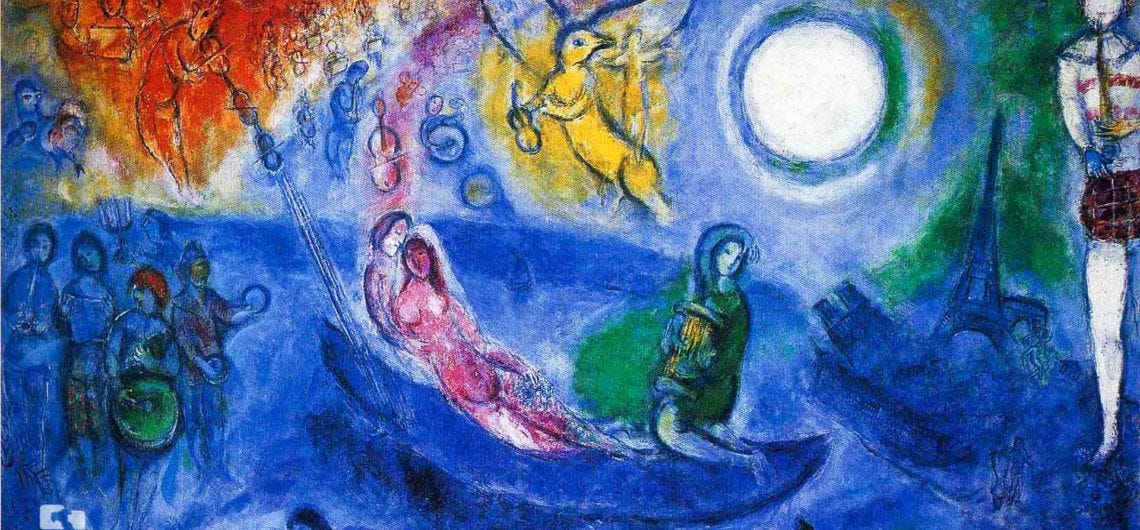
Pisces is the last sign of the zodiac — mutable water, the sign in which boundaries give out entirely. Its traditional ruler is Jupiter: the expansive, the meaning-making, the one who reaches always for the widest possible frame. Jupiter retrograde in Cancer right now is pulling that meaning-making energy inward — into home, into the emotional body, into the original stories we absorbed before we could question them. The frame is being renegotiated from the inside.
Water signs are often described as “emotional,” but more precisely, they are absorptive. They take in tone, subtext, implication. The problem is that absorption is not verification.
Carl Jung described the ocean as a symbol of the collective unconscious — a vast psychic reservoir containing images and experiences that exceed individual memory. Pisces represents proximity to that reservoir and the gift is access. The risk is conflation: mistaking the archive of feeling for a complete account of events.
The Piscean wound is this: you sense something is true before you can prove it. The emotional transmission is intact but the documentation is incomplete.
And that gap is exploitable.

Testimony and the Limits of Precision
Judgment at Nuremberg is a 1961 Stanley Kramer film about the post-war tribunal of four German judges charged with crimes against humanity. Much of the film centers on witness testimony.
Trauma does not produce orderly recall. Witnesses contradict themselves. They cannot always supply exact dates or seating arrangements. At one point, a woman is cross-examined so aggressively about minor inconsistencies that the courtroom becomes a second violation.
The defense strategy is clear: if memory is imprecise, it must be unreliable.
But the tribunal reaches a different conclusion. Individual testimonies are partial. Together, they establish truth. The archive is assembled from fragments.
This is an important distinction: subjective accounts can be factually incomplete and still directionally accurate. Precision and truth are not identical.
What makes the film devastating is the figure of Ernst Janning — a defendant and former Nazi judge who, when he finally speaks, tears open his own archive. He confesses not just to the crimes he sanctioned, but to the internal narrative that made compliance possible. The story he told himself, refined across years, until it felt like conviction rather than capitulation. The imagination, turned toward self-justification, becomes its own kind of archival corruption. The story told to survive becomes the memory.

The Narrative as Egregore: What Happened to Sylvia. What Happened Last Week.
An egregore is a collective thoughtform that takes on autonomous life through sustained attention. The more people repeat it, cite it, grant it authority — the more it overwrites competing accounts. It becomes, over time, what people believe actually happened.
Velvet Goldmine is about exactly this: how cultural mythology is made from projections, desires, griefs, and whoever had the most access to the narrative machinery. Its opening disclaimer: “Although what you are about to see is a work of fiction, it should nevertheless be played at maximum volume.”
The problem is when the egregore serves the wrong person.
Hughes had total legal control of Plath’s work after her death because she died without a will. He burned diaries. He rearranged poems. He characterized her as fated to self-destruct — as if his actions were irrelevant weather, and she was a force of nature moving toward an inevitable extinction. Van Duyne documents this across nearly three hundred pages. A third novel: gone from the archive. Permanently.
Van Duyne’s most cutting formulation: “The immediate correlation of Plath’s suicide with her poetry has trained us to hear the many voices she left behind as coming from beyond the grave, rather than as the record of her life — a unique form of censorship.”
Not the burning of books, though he burned those too. The subtler act: reframing the archive so that everything in it becomes evidence for the story you want to tell.
Now: the United States bombs Iran.
Before the bombs, there was an archive being assembled. Not secretly — openly, in press briefings and op-eds and carefully timed intelligence leaks. The narrative preceded the action. This is how modern (or… all history of?) war works: you do not bomb a country and then explain why. You build the story first, until the bombing feels inevitable. Until it feels, to enough people, like the only possible conclusion to a sequence of events that was never quite as clear as the official account suggested.
I have been thinking about my novel, which is set in 1100s French Aquitaine and concerns — among other things — how narrative is controlled in order to go to war. Whether the story was ever about the stated reason, or whether the reason was always the story told to make the action legible.
The egregore of threat. The egregore of necessity. Repeated, repetition as insistence.
Mercury retrograde in Pisces is the transit of the garbled transmission, the story that won’t resolve, the feeling that you’re receiving something true that you cannot quite articulate. This is the season when the official narrative is most likely to feel wrong in your body before you can explain why. Trust that. The felt truth is a legitimate form of archival evidence. The question is whether you have a witness — someone who will sit with the imprecision of your account and listen for the shape of it, rather than demanding the precision it can’t deliver.
Assia Wevill, the woman Hughes left Plath for, killed herself and their four-year-old daughter in 1969. After her death, Hughes began a campaign to obscure and then erase her existence from memory. Two women. Two erasures. One man who controlled the archive in both cases.
The structure is always the same… but the names change.
The Body That Lets the Water Move Through
Harold, in Harold and Maude, is soaked in death. He stages fake suicides. He attends strangers’ funerals. He is trapped in an anxiety archive — a recursive loop of anticipated abandonment, running the same catastrophic scenario because he cannot find his way to a different outcome.
This is what anxiety does with Piscean imagination: it rehearses catastrophe, building its case from the partial archive of past hurt. The archive is corrupted. The anxiety is running on corrupted data.
Then there is Maude.
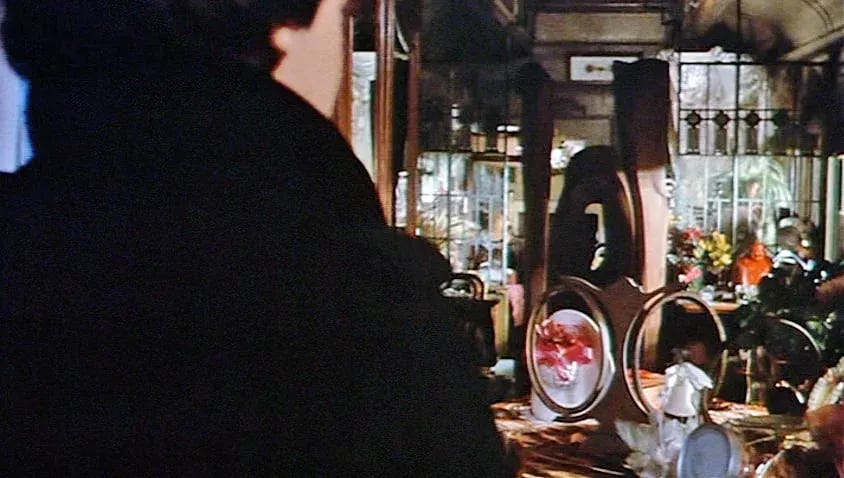
She has five digits tattooed on her forearm. (We can assume from her time at Auschwitz.) The film holds this for less than a second, then moves on. She lives in a converted train car — a deliberate subversion: she has taken the vehicle of the death camp and made it a shrine to her continuing presence. She owns a machine that replicates the smell of fresh snow! These are memory-adjacent objects, tools for conjuring feeling rather than preserving fact.
When Harold finds the tattoo and she pulls her arm away, she points upward. Not explanation, not narrative. Just: look at what’s still here.
Maude says: “A lot of people enjoy being dead. But they are not dead, really. They’re just backing away from life.”
She has metabolized her history rather than been metabolized by it. The anxiety has moved through the body, as anxiety must. Water needs a vessel. The felt truth needs flesh to travel through. What remains on the other side is not forgetting — it is Maude, pointing up. Still fighting for the big issues, she says, but now in my small, individual way.
So What Does Pisces Season Ask?
Pisces season — especially under Mercury retrograde in Pisces — heightens sensitivity to narrative distortion. Mercury governs communication, media, framing. In Pisces, information can feel foggy or emotionally charged before it feels logically coherent.
Instead of dismissing that sensation, examine it.
When something feels “off,” ask:
What story is being repeated?
Who benefits from its repetition?
What alternative accounts exist?
Where might emotional truth be present even if documentation is incomplete?
The goal is not to privilege feeling over fact. But we can recognize that feeling signals where to investigate further.
Witness consciousness — listening without prematurely forcing coherence — is different from credulity. The judges at Nuremberg did not abandon standards of evidence. They contextualized inconsistency within trauma.
Van Duyne did not replace one myth with another. She returned to primary sources.
Pisces, at its best, asks for that kind of attention.
Where This Lands Personally
Find where Pisces falls in your chart. That’s where you’re most likely to have absorbed someone else’s version of the story as your own memory.
Pisces in the 1st House: The egregore of who you are. Early stories about who you are may have hardened into identity.
Pisces in the 10th House: The professional myth — what the public has decided you are, which may bear only atmospheric resemblance to your actual work.
Pisces in the 12th House: Deep unconscious material may shape decisions without conscious awareness.
In each of these places: what story has been told so many times it has become your memory? What did you feel, before you knew the story you were supposed to tell?
Prompts for Piscean Witness
For contemplation:
Where has someone else’s version of your story been repeated so many times you’ve started to experience it as your own account of what happened?
What collective story about you (told by family, by culture, by a particular critical tradition) has been reinforced by whoever had access to the archive?
If you approached the corrupted parts of your own inner archive the way Van Duyne approached Plath’s (forensically, lovingly, with the willingness to find what was actually there rather than what you expected) what do you think you might find?
Tarot Spread: The Corrupted Archive
The Ocean — What collective story am I swimming in right now, shaping my perception without my full awareness?
The Burned Document — What has been suppressed or made unavailable to me — by someone else’s telling, or by my own?
The Felt Truth — What is my own actual account of this, in the body, before it was written over?
The Vessel — What grounds me enough to hold the Piscean depth without dissolving into the current?
Some updates from life: I am looking for practice partners for Astro Parts Work method I am developing. If you are interested in getting acquainted with your planets as parts of you, fill out this interest form and I will reach out soon.
Chelsea Owens and I are launching Season Two of Parts & Charts on the vernal equinox and I really really want to show you who we’re talking to and about what!
Writing this in Pisces season, Mercury retrograde, thinking about what gets burned and what doesn’t. What’s your relationship to the archive — the stories told about you that you’ve started to believe? I’d love to hear in the comments, especially if you have Pisces or 12th house placements that feel relevant.
A Capricorn Rising writing this, with a Pisces 3rd House — a predilection toward thinking, remembering, and speaking in the non-specific Piscean way, and not always happy about it.
Love love love this piece so much, KP. Fascinated (and devastated) by the curated archive of Plath. And the part about the water holding the geography/chemistry but not the event??? Crack me WIDE open.
I’m going to be sitting with the first reflection question for a while. It immediately made me think of my ADHD/Autism discovery and how much rewriting of my narrative has happened in that process. Looking back at little Jenna who had a different story of being a sensitive worried little girl imprinted on her. Sigh. Thank you 🙏🏼💕
This is so GOOD!!!! Also velvet goldmine is one of my favorite movies of all time